Aaron Rodgers and Radhakishan Damani: Two Different Paths to Extraordinary Success

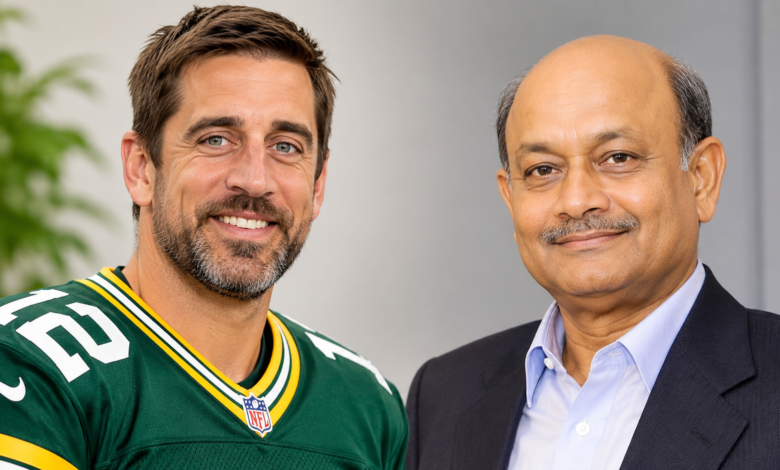
When people search for Aaron Rodgers and Radhakishan Damani, they may initially wonder what connects an American football superstar with one of India’s most influential retail entrepreneurs. The simple answer is that they come from completely different worlds. Rodgers built his reputation through professional football, while Damani created his wealth and influence through business, investing, and retail. Yet, when their careers are viewed side by side, there are some fascinating similarities in the way both men approached long-term success.
Aaron Rodgers became one of the most accomplished quarterbacks in NFL history after entering the league with the Green Bay Packers in 2005. His career later took him to the New York Jets and then the Pittsburgh Steelers. NFL records list Rodgers with four Most Valuable Player awards and a Super Bowl XLV MVP honor, highlighting just how significant his career has been.
Radhakishan Damani followed an entirely different route. Rather than building his name on a sports field, he developed a business philosophy centered on disciplined operations, competitive pricing, and understanding everyday consumers. His most recognizable achievement is DMart, the supermarket chain operated by Avenue Supermarts. The company says the first DMart store opened in Powai, Mumbai, in 2002.
Who Is Aaron Rodgers?
Aaron Rodgers is an American professional football quarterback who has spent more than two decades competing at the highest level of the NFL. He was selected by the Green Bay Packers in the first round of the 2005 NFL Draft and initially spent several seasons learning behind Brett Favre before eventually becoming the team’s starting quarterback.
His breakthrough transformed both his career and the Packers’ future. Rodgers developed a reputation for exceptional accuracy, decision-making, arm strength, and an ability to make difficult throws look surprisingly easy. Over the years, he became particularly well known for protecting the football while still producing big plays.
The numbers demonstrate the scale of his career. NFL statistics list Rodgers with more than 68,000 passing yards and 540 touchdown passes through the 2026 season data available on the league’s website. He also earned four NFL MVP awards, making him one of the most decorated quarterbacks of his generation.
Aaron Rodgers’ Career and Legacy
Rodgers’ Green Bay years form the most important chapter of his professional story. After taking over as the Packers’ starting quarterback, he quickly established himself as one of the league’s elite players. His performances combined efficiency with explosiveness, creating a style that made him difficult for opposing defenses to predict.
One of the defining moments of his career came during the 2010 season when the Packers won Super Bowl XLV. Rodgers was named Super Bowl MVP after throwing for 304 yards and three touchdowns. His postseason performances during that period helped cement his reputation beyond regular-season statistics.
His career continued through major changes. Rodgers eventually moved from Green Bay to the New York Jets in 2023 and later joined the Pittsburgh Steelers. NFL’s current player information lists him as Pittsburgh’s No. 8 quarterback in 2026. His decision to continue playing into the 2026 season also added another chapter to an already remarkable career.
Who Is Radhakishan Damani?
Radhakishan Damani is an Indian businessman and investor best known as the founder of DMart. Unlike Rodgers, whose career depends on performance in front of millions of sports fans, Damani built his reputation quietly through business decisions, investment discipline, and retail expansion.
DMart’s story is particularly interesting because its model focuses on products people buy regularly. The retailer offers groceries, food products, household goods, personal-care products, and other everyday essentials. According to DMart’s official careers site, the company’s mission is to be the lowest-priced retailer in the regions it serves.
That simple proposition became a major part of the company’s identity. Instead of relying only on luxury experiences or complicated retail concepts, the business focused on affordability, convenience, and operational efficiency. This approach helped turn DMart into one of India’s most recognizable retail chains.
The Rise of DMart
DMart opened its first store in Powai, Mumbai, in 2002. From that beginning, the company expanded across several Indian states and regions. Its official information currently describes a network of more than 500 stores across 10 states, the National Capital Region, and one Union Territory.
The growth of DMart illustrates an important business lesson: a company does not always need an extravagant concept to become successful. Sometimes, understanding what ordinary customers want and delivering it consistently can be more powerful.
Damani’s approach has often been associated with discipline and long-term thinking. Instead of chasing every trend, the broader DMart model has emphasized value, efficiency, and repeat customer demand. That creates a very different form of competitive advantage from the one Rodgers developed on the football field.
Aaron Rodgers and Radhakishan Damani: What Do They Have in Common?
There is no established public business partnership or personal relationship between Aaron Rodgers and Radhakishan Damani that should be presented as fact. Their connection is primarily an interesting comparison between two highly successful individuals from completely different industries.
The first similarity is consistency. Rodgers remained at the top level of professional football for many years, while Damani built a retail organization designed around long-term expansion. Neither story is based on one lucky moment. Both involve years of decisions, adaptation, and sustained execution.
The second similarity is their understanding of their respective environments. Rodgers had to read defenses, recognize opportunities, adjust to changing situations, and make decisions within seconds. Damani’s world requires understanding consumers, prices, competitors, store operations, and changing economic conditions. The skills are different, but both involve identifying opportunities while managing risk.
Different Industries, Similar Lessons
Sports and retail may appear completely unrelated, but successful people in both fields often share certain characteristics. Preparation is one of them. An elite quarterback cannot rely purely on natural talent, just as a successful retailer cannot depend only on having access to capital.
Rodgers’ career demonstrates the importance of preparation and adaptability. Even after changing teams and entering different stages of his career, he continued adjusting to new circumstances. His 2026 season with Pittsburgh is another example of an experienced athlete adapting to a changing professional environment.
Damani’s career offers a similar lesson from the business world. Building DMart required patience rather than instant results. Retail expansion involves logistics, purchasing, real estate, employees, customer expectations, and competition. Success comes from getting hundreds of small operational decisions right over a long period.
Leadership Styles of Aaron Rodgers and Radhakishan Damani
Leadership looks different depending on the environment. Rodgers’ leadership developed within a highly visible team sport where communication, trust, performance, and accountability matter every week. As a quarterback, he has traditionally occupied one of the most influential positions on the football field.
Damani’s leadership has been more closely connected with business strategy and organizational culture. DMart describes its approach in terms of discipline, teamwork, customer focus, and relentless attention to its retail mission.
That contrast is useful because it shows that there is no single formula for leadership. A professional athlete may lead through performance and decision-making under pressure, while an entrepreneur may lead by building systems that allow an organization to perform consistently at scale.
Wealth, Success, and Public Attention
Another interesting difference between Aaron Rodgers and Radhakishan Damani is the way their success is experienced by the public. Rodgers operates in an industry where personal visibility is unavoidable. Games are televised, statistics are published, interviews are widely circulated, and every major performance can become a headline.
Damani’s success has traditionally been more business-focused. Although his wealth and influence have attracted considerable attention, his reputation is strongly connected to the growth of DMart and his investment career rather than entertainment-style celebrity.
This difference highlights two types of modern success. One is built through public performance, where millions of people watch the individual directly. The other is built through ownership, strategy, and an organization whose performance reflects decisions made behind the scenes.
What We Can Learn From Their Stories
The stories of Aaron Rodgers and Radhakishan Damani offer several useful lessons. First, expertise develops over time. Rodgers did not become an elite quarterback overnight, and Damani did not build DMart into a major retailer immediately after opening the first store.
Second, consistency matters more than short-term excitement. Rodgers’ career includes more than 270 NFL games in the league’s current career statistics, while Damani’s retail story stretches from DMart’s first store in 2002 to a network now exceeding 500 stores according to the company’s current information.
Finally, successful people usually understand their environment deeply. Rodgers mastered the complexities of professional football, while Damani developed a business model based around everyday retail demand. Their methods are not interchangeable, but the underlying principle is similar: understand the game you are playing and become exceptionally good at it.
Frequently Asked Questions
Are Aaron Rodgers and Radhakishan Damani related?
There is no reliable public information establishing that Aaron Rodgers and Radhakishan Damani are related. They are prominent figures from entirely different industries and countries.
What is Aaron Rodgers famous for?
Aaron Rodgers is best known for his career as an NFL quarterback. He spent the majority of his career with the Green Bay Packers, won Super Bowl XLV, and has received four NFL MVP awards.
What is Radhakishan Damani famous for?
Radhakishan Damani is best known as the founder of DMart and for his role in building Avenue Supermarts into a major Indian retail business. DMart opened its first store in Mumbai in 2002.
Are Aaron Rodgers and Radhakishan Damani business partners?
There is no established public evidence that Aaron Rodgers and Radhakishan Damani are business partners. Any claim suggesting a formal partnership should be supported by a reliable source before being treated as fact.
Why are Aaron Rodgers and Radhakishan Damani mentioned together?
The two names can be compared because both represent significant success in their respective fields. Rodgers is associated with elite professional football, while Damani is associated with Indian retail and entrepreneurship.
Final Thoughts on Aaron Rodgers and Radhakishan Damani
At first glance, Aaron Rodgers and Radhakishan Damani seem to have almost nothing in common. One built a legendary career as an NFL quarterback, while the other developed one of India’s best-known retail businesses. Their industries, audiences, and professional environments are completely different.
Look a little deeper, though, and their stories share a broader theme: long-term success requires discipline, adaptability, and the ability to make good decisions repeatedly. Rodgers turned elite athletic ability into a career spanning more than two decades, while Damani turned a straightforward retail idea into a large-scale business.
That is ultimately what makes the comparison interesting. Their success did not come from following the same path. It came from mastering very different paths. Whether the arena is an NFL stadium or a retail market, the fundamentals remain surprisingly familiar: understand your environment, stay disciplined, learn from change, and keep improving over time.
You May Also Read; Ray Dalio and Patricia Poppe