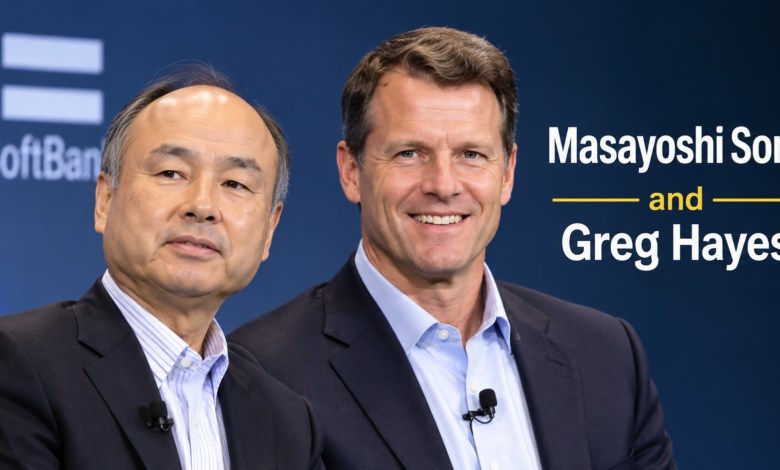
When the names Masayoshi Son and Greg Hayes appear together, it is easy to assume there is a direct business partnership or shared corporate history between them. In reality, their professional journeys have largely developed in different industries. Masayoshi Son is best known as the founder and longtime leader of SoftBank Group, with a career built around technology, telecommunications, investment, and artificial intelligence. Greg Hayes, meanwhile, became one of the most influential executives in American aerospace and defense through his leadership of United Technologies and RTX.
That difference is exactly what makes Masayoshi Son and Greg Hayes an interesting comparison. Both executives have dealt with enormous organizations, major strategic decisions, acquisitions, technological change, and long-term corporate transformation. Yet they approached leadership from very different angles. Son has often operated as a visionary investor willing to make enormous bets on emerging technologies, while Hayes built his reputation through disciplined corporate management, restructuring, integration, and operational execution.
There is no well-established public evidence that the two are direct business partners, relatives, or executives within the same company. Instead, the useful way to understand Masayoshi Son and Greg Hayes is to look at their individual careers and compare the leadership philosophies that helped each man navigate complex global businesses.
Who Is Masayoshi Son?
Masayoshi Son is the founder, Chairman, and CEO of SoftBank Group. He founded Nihon SoftBank in 1981, initially building a business around PC software distribution before expanding into internet businesses, telecommunications, technology investments, and artificial intelligence. SoftBank’s own history describes this evolution as a progression from PCs and software to the internet, mobile communications, and eventually AI, IoT, and smart robotics.
One of the defining characteristics of Son’s career is his willingness to think far beyond the immediate business cycle. He has repeatedly tried to identify technologies that could become foundational to the next generation of computing. His investment history includes major involvement with companies and technologies connected to internet services, telecommunications, e-commerce, semiconductors, and artificial intelligence.
Arm is an especially important part of this strategy. SoftBank acquired Arm in 2016, and Son later became chairman of Arm. The company has become a major piece of the global semiconductor ecosystem, giving SoftBank exposure to the underlying architecture used across a huge range of computing devices.
Son’s recent strategic thinking has become increasingly centered on artificial intelligence and what he calls artificial superintelligence. In SoftBank’s 2025 annual report message, he described a long-running fascination with computing and argued that the development of increasingly capable AI could represent a transformational moment for humanity and business.
Who Is Greg Hayes?
Gregory J. Hayes built his career in a very different environment. His professional background is strongly associated with United Technologies Corporation and RTX, the aerospace and defense company formed through the combination of UTC’s aerospace businesses and Raytheon.
Hayes spent nearly 21 years at United Technologies, holding senior positions across finance, corporate strategy, and business development. He became CEO of UTC in 2014 and chairman in 2016. During his leadership, the company underwent a major transformation, including the divestiture of Sikorsky Aircraft, the acquisition of Rockwell Collins, and the later separation of Otis and Carrier.
The creation of RTX was one of the biggest chapters of Hayes’s career. In 2020, UTC’s remaining aerospace businesses, including Pratt & Whitney and Collins Aerospace, were combined with Raytheon to create RTX. Hayes became CEO of the newly formed company and helped guide it through a major period of integration and industry change.
Hayes later moved through a carefully planned leadership transition. Christopher Calio succeeded him as CEO in 2024, while Hayes became executive chairman. Hayes then stepped down as executive chairman and from the RTX board in April 2025, remaining as a special advisor through January 2, 2026.
As of 2026, Hayes has continued his corporate leadership career outside RTX. Phillips 66 appointed him Lead Independent Director in May 2026, and he also serves on the board of Becton, Dickinson and Company.
Masayoshi Son and Greg Hayes Took Different Paths to the Top
The biggest contrast between Masayoshi Son and Greg Hayes is the type of business environment in which each executive developed his reputation.
Son’s career has been closely connected to technology markets where the future can be difficult to predict. A company can invest in an emerging technology before its commercial potential becomes obvious, and the payoff may take years. That environment naturally rewards imagination, patience, risk tolerance, and the ability to recognize technological shifts early.
Hayes’s world has traditionally demanded a different set of skills. Aerospace and defense companies operate with enormous engineering programs, complex supply chains, government relationships, safety requirements, and long production cycles. Decisions need to balance innovation with reliability, cost control, execution, and regulatory considerations.
This does not mean one approach is better than the other. Instead, Masayoshi Son and Greg Hayes demonstrate how leadership can look very different depending on the business environment. Son often asks what an industry could become decades from now. Hayes’s record shows a strong emphasis on how large organizations can be reshaped and executed effectively today while preparing for the future.
Their Approach to Corporate Transformation
Transformation is another area where Masayoshi Son and Greg Hayes can be compared. Son has transformed SoftBank several times during his career. The company moved from software distribution into internet businesses, telecommunications, technology investments, and eventually a strategy increasingly focused on AI and computing infrastructure.
That ability to reinvent the company has been central to Son’s identity as an entrepreneur. Instead of treating SoftBank’s original business model as permanent, he repeatedly changed the company’s direction as new technologies emerged. The acquisition of Arm was one example of this long-term technology strategy.
Hayes approached transformation from the perspective of a large industrial organization. His work at United Technologies involved reshaping a diversified conglomerate and concentrating it more heavily on aerospace. The eventual creation of RTX represented another significant transformation, bringing together major aerospace businesses from UTC and Raytheon.
The difference is subtle but important. Son’s transformations have often been driven by emerging technology and investment opportunities, while Hayes’s transformations were heavily connected to portfolio management, industrial strategy, mergers, operational structure, and long-term corporate competitiveness.
Risk and Decision-Making
Risk is one of the most interesting areas when comparing Masayoshi Son and Greg Hayes. Son has become famous for making ambitious bets on technologies and companies that he believes could reshape entire industries. Some of these decisions have produced enormous successes, while others have created substantial financial challenges.
The SoftBank story therefore contains both sides of aggressive strategic investing. The company’s investments in companies such as Alibaba became legendary successes, while some Vision Fund investments experienced severe setbacks. Son’s willingness to continue making large technology bets has remained a defining part of his leadership style.
Hayes’s risk management background developed in a more traditional corporate setting. Aerospace businesses cannot simply experiment with the same freedom as venture investors. Aircraft engines, defense systems, and other complex products involve safety, engineering, manufacturing, contracts, and long-term customer relationships.
That difference gives Masayoshi Son and Greg Hayes very different relationships with uncertainty. Son has often embraced uncertainty as part of technological disruption. Hayes’s leadership record suggests a greater emphasis on managing complexity, allocating capital carefully, integrating businesses, and creating a structure that can operate reliably at enormous scale.
Technology Played a Major Role in Both Careers
Although their industries are different, technology connects the stories of Masayoshi Son and Greg Hayes more than it might initially appear.
For Son, technology is essentially the center of the investment thesis. SoftBank has expanded into areas including AI, advanced telecommunications, smart robotics, and semiconductor technology. Arm, in particular, gives SoftBank a strategic position in computing architecture.
For Hayes, technology was embedded in aerospace and defense. RTX operates through businesses such as Collins Aerospace, Pratt & Whitney, and Raytheon, where engineering, digital systems, advanced manufacturing, aircraft engines, and defense technologies are fundamental to competitiveness.
This creates an interesting comparison. Son looks at technology primarily as an engine for future economic transformation, investment opportunities, and new industries. Hayes operated in a sector where technology has to translate into dependable products, engineering performance, manufacturing capability, and customer value.
Leadership Lessons From Masayoshi Son and Greg Hayes
One lesson from Masayoshi Son and Greg Hayes is that successful leadership does not require following a single formula. Son demonstrates the power of having a strong long-term vision and being willing to make unconventional decisions. His career shows how an entrepreneur can repeatedly reposition a company as technology changes.
Hayes demonstrates another important leadership principle: transformation requires execution. Creating a strategy is only the beginning. Large organizations have to integrate acquisitions, restructure businesses, manage employees, maintain customer relationships, allocate capital, and establish succession plans.
Their careers also demonstrate why adaptability matters. Son did not remain focused on the business SoftBank started with in 1981. Hayes likewise did not simply preserve United Technologies in its previous form. Both leaders participated in major organizational changes rather than assuming that yesterday’s corporate structure would automatically work tomorrow.
For younger entrepreneurs and executives, the broader lesson is straightforward. Vision matters, but execution matters too. A bold idea without implementation can fail, while excellent execution without a clear strategic direction can leave a company reacting to competitors instead of shaping its industry.
What Their Careers Say About the Future
Looking at Masayoshi Son and Greg Hayes in 2026 also highlights two different ideas about the future of business.
Son remains closely associated with SoftBank’s technology ambitions, particularly AI and advanced computing. SoftBank’s current corporate messaging places artificial superintelligence at the center of its long-term vision, building on the company’s existing exposure to semiconductor technology and AI-related investments.
Hayes, meanwhile, has moved into a broader governance phase of his career. His appointment as Lead Independent Director of Phillips 66 shows how experienced CEOs can continue influencing large organizations even after leaving day-to-day executive leadership.
That transition is important because corporate leadership does not necessarily end when someone leaves the CEO office. Experienced executives can contribute through boards, governance, strategic advice, and oversight. Hayes’s current role reflects that evolution.
Masayoshi Son and Greg Hayes: A Useful Comparison
Ultimately, Masayoshi Son and Greg Hayes represent two distinct models of modern corporate leadership. Son is the technology entrepreneur and investor whose career has been shaped by enormous bets on what he believes the future will look like. Hayes is the corporate strategist and industrial executive whose career has been shaped by transformation, mergers, operational discipline, and governance.
| Category | Masayoshi Son | Greg Hayes |
| Best known for | Founding and leading SoftBank | Leading UTC and RTX |
| Primary industries | Technology, telecommunications, investment, AI | Aerospace, defense, industrials |
| Leadership style | Vision-driven and investment-focused | Operational and transformation-focused |
| Major strategic theme | Technology and AI | Aerospace consolidation and corporate transformation |
| Major company association | SoftBank Group | RTX / United Technologies |
| Current leadership focus | SoftBank and technology strategy | Corporate boards and governance |
The comparison also makes one point especially clear: being mentioned together does not necessarily mean two executives worked together. Public corporate records do not establish a direct partnership between Son and Hayes. Their connection is better understood as a comparison between two prominent business leaders who operated in very different environments.
Final Thoughts on Masayoshi Son and Greg Hayes
The stories of Masayoshi Son and Greg Hayes offer a fascinating look at how leadership changes across industries. Son built a technology and investment empire by repeatedly betting on major technological shifts, from personal computing and the internet to telecommunications, semiconductors, and artificial intelligence. Hayes built his reputation by reshaping major industrial businesses and helping create one of the world’s most important aerospace and defense companies.
Their careers are different, but both demonstrate the importance of making difficult decisions before the outcome is obvious. Son’s story emphasizes vision, technological ambition, and risk-taking. Hayes’s story emphasizes strategic restructuring, integration, operational discipline, and succession.
That is what makes Masayoshi Son and Greg Hayes worth studying together. They are not simply two famous executives from different companies. They represent two different approaches to navigating change—and in an economy increasingly shaped by technology, global competition, and constant disruption, both approaches offer valuable lessons.
You May Also Read: James Quincey and Pedro Pizarro