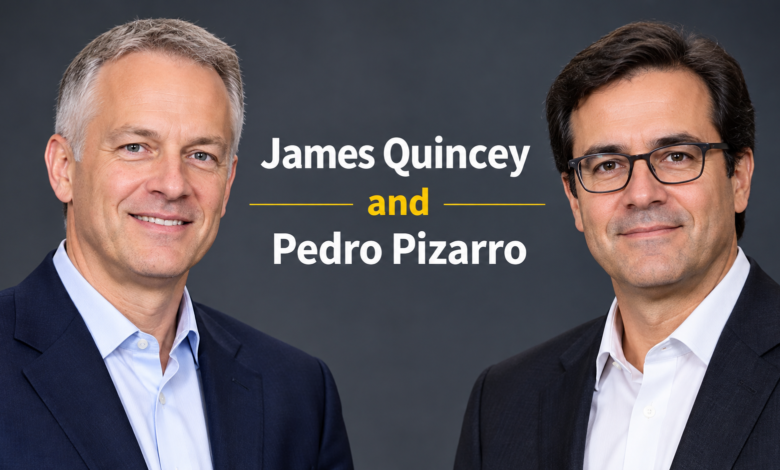
When people talk about influential corporate leaders, they often focus on CEOs from the same industry. But James Quincey and Pedro Pizarro offer a more interesting comparison because their careers developed in very different sectors. Quincey built his reputation in the global beverage industry through a long career at The Coca-Cola Company, while Pizarro rose through Edison International and became a major figure in the U.S. electric utility sector.
Although their industries are worlds apart, both executives have something important in common: they developed their leadership careers by taking on increasingly complex responsibilities inside major organizations. Their stories show how technical knowledge, strategic thinking, international experience, and the ability to manage change can shape a successful executive career.
Looking at James Quincey and Pedro Pizarro together also provides a useful lesson about modern corporate leadership. One has spent decades managing brands, consumers, markets, and global operations, while the other has worked with electricity infrastructure, regulation, technology, safety, and business resilience. Their paths are different, but both demonstrate the importance of adapting leadership to the challenges of a particular industry.
Who Is James Quincey?
James Quincey is a British business executive who spent almost three decades building his career at Coca-Cola. He joined the company in 1996 and worked through a series of leadership positions before eventually becoming CEO in 2017 and chairman of the board in 2019. In 2026, he stepped down from the CEO position and continued as Executive Chairman.
Quincey’s career at Coca-Cola is notable because it was not limited to one market or one type of responsibility. He worked across Latin America and Europe and held leadership roles involving business operations, strategy, acquisitions, and brand development. Before becoming CEO, he served as president and chief operating officer, giving him broad exposure to the company’s worldwide operations.
His background also includes consulting experience. Before joining Coca-Cola, Quincey was a partner in strategy consulting at The Kalchas Group, a firm described by Coca-Cola as a spinoff of Bain & Company and McKinsey. He later used that strategic experience inside Coca-Cola while moving through international management roles.
Who Is Pedro Pizarro?
Pedro J. Pizarro is the President and CEO of Edison International, the parent company of Southern California Edison. He has spent much of his professional career within the Edison organization and has worked across areas including strategy, operations, power procurement, generation, and business development.
Pizarro joined Edison International in 1999 and moved to Southern California Edison in 2001. His career continued to develop through several management positions, eventually leading him to Edison Mission Energy, where he served as president before returning to senior leadership at Edison International. He became president of Edison International in 2016 and CEO later that year.
One of the most distinctive parts of Pizarro’s background is his scientific education. He earned a bachelor’s degree in chemistry from Harvard University and a Ph.D. in chemistry from the California Institute of Technology. Before joining Edison, he worked as a senior engagement manager at McKinsey & Company, where his work included corporate strategy, mergers and acquisitions, and operational engagements.
James Quincey and Pedro Pizarro Have Different Industries but Similar Career Patterns
At first glance, James Quincey and Pedro Pizarro appear to have little in common. Quincey is associated with consumer beverages and one of the world’s most recognizable brands, while Pizarro leads a major electric utility organization. Their industries have different customers, regulations, risks, and operational priorities.
However, their career paths reveal a similar pattern. Both executives spent many years developing expertise before reaching the highest levels of corporate leadership. Neither simply entered a company and immediately became a top executive. Instead, both progressed through multiple roles that gave them a broader understanding of their organizations.
That long-term internal experience can be particularly valuable for large corporations. An executive who has worked across multiple departments and business units can understand how decisions affect employees, customers, investors, suppliers, regulators, and other stakeholders. This type of experience is visible in both Quincey’s and Pizarro’s professional histories.
Quincey’s Leadership at Coca-Cola
James Quincey’s time at Coca-Cola included several important international assignments. He served as president of the Mexico division, president of the Northwest Europe and Nordics business unit, and president of the Europe Group before moving into the company’s global leadership team.
During his career, Quincey was involved with important portfolio and acquisition decisions. Coca-Cola’s own biography notes his role in the acquisition of innocent juice while he was leading the Northwest Europe and Nordics business unit. He also led the Mexico division during a period that included the acquisition of Jugos del Valle and changes to the company’s beverage portfolio.
This international experience became an important part of his leadership profile. Coca-Cola operates across a huge range of markets, and consumer preferences can differ dramatically from one country to another. Managing such an organization requires executives to balance global brand consistency with local market realities. Quincey’s career gave him firsthand experience with that challenge.
Pizarro’s Leadership at Edison International
Pedro Pizarro’s leadership environment is very different. Electric utilities deal with infrastructure, reliability, safety, regulation, cybersecurity, technology, energy markets, and long-term capital investment. Edison International’s leadership profile highlights Pizarro’s experience in areas including risk management, strategic planning, workforce management, cybersecurity, technology and innovation, and environmental sustainability.
Pizarro’s previous role at Edison Mission Energy also gave him experience in the competitive energy market. Edison Mission Energy was involved in owning, leasing, operating, and selling energy and capacity from power-generation facilities, as well as energy trading and hedging activities.
This background helps explain why Pizarro’s leadership profile combines scientific knowledge with business strategy. Managing a modern utility is not simply about keeping the lights on. It involves anticipating technological changes, managing physical and digital risks, working with regulators, investing in infrastructure, and preparing for unexpected disruptions.
How Their Educational Backgrounds Shaped Their Careers
Education is another interesting difference between James Quincey and Pedro Pizarro. Quincey studied electronic engineering at the University of Liverpool, while Pizarro studied chemistry at Harvard and continued to earn a Ph.D. in chemistry from Caltech.
Neither executive followed a traditional business-school-only route. Instead, both developed technical or scientific foundations before moving deeply into management and strategy. Their careers demonstrate that senior corporate leadership can emerge from many educational backgrounds.
For modern professionals, this is an encouraging point. A technical degree does not necessarily limit someone to a technical career. Engineering, science, mathematics, technology, and other specialized fields can provide analytical skills that later become useful in management, strategy, operations, and executive decision-making.
Their Consulting Experience Created a Strategic Foundation
Another similarity between James Quincey and Pedro Pizarro is their connection to management consulting. Quincey worked with The Kalchas Group before joining Coca-Cola, while Pizarro worked as a senior engagement manager at McKinsey & Company before his career at Edison.
Consulting can provide executives with exposure to different companies, business problems, industries, and strategic frameworks. It also requires professionals to analyze complicated problems quickly and communicate recommendations clearly. Those abilities can be valuable later when managing large organizations.
Their careers show how consulting experience can become a stepping stone rather than a final destination. Both eventually moved into operating roles where they were responsible not only for recommending strategies but also for executing them and dealing with the consequences of business decisions.
Leadership Lessons From James Quincey and Pedro Pizarro
One major lesson from James Quincey and Pedro Pizarro is the value of learning an organization from the inside. Both spent many years progressing through different roles, which allowed them to understand their businesses at multiple levels.
Another lesson is that successful executives need to understand change. Coca-Cola has had to respond to shifting consumer preferences, changing beverage categories, digital transformation, and evolving expectations around products and brands. Edison International faces a different set of changes involving electricity demand, infrastructure, technology, resilience, regulation, and the broader energy transition.
Their careers also demonstrate the importance of communication. A CEO must communicate with employees, investors, government officials, customers, boards, and business partners. Technical knowledge alone is not enough. Leaders need to translate complicated issues into understandable goals and decisions.
What Makes Their Leadership Styles Interesting?
James Quincey’s leadership has been strongly associated with global brand management, portfolio development, international operations, and strategic transformation. His career at Coca-Cola gave him experience across different cultures and markets, which is especially relevant for a company with a worldwide presence.
Pizarro’s leadership style is shaped more heavily by infrastructure, resilience, safety, regulation, science, and operational risk. Edison International identifies these areas as important elements of his experience, reflecting the unique demands of the utility industry.
That difference is what makes the comparison useful. Leadership does not have one universal formula. The skills required to manage a global consumer brand are not identical to those needed to operate a critical infrastructure business. Yet strategic thinking, accountability, adaptability, and communication remain valuable in both environments.
James Quincey’s Next Chapter
James Quincey’s career entered a new phase in 2026. Coca-Cola announced a succession plan in which Henrique Braun would become CEO, while Quincey would continue as Executive Chairman. The company said Quincey was stepping down as CEO after a 30-year career with Coca-Cola.
This transition is significant because Quincey spent so much of his professional life within the Coca-Cola system. Moving from CEO to Executive Chairman allows him to remain involved at the board level while handing day-to-day executive leadership to a successor.
His continuing corporate involvement also includes board service. Coca-Cola identifies him as a director of Pfizer, while Pfizer confirms that he became Executive Chairman of Coca-Cola after stepping down as CEO effective March 31, 2026.
Pedro Pizarro’s Continuing Role in the Energy Industry
Pedro Pizarro continues to lead Edison International, where his work is connected to the evolving needs of the electric power sector. His responsibilities involve a combination of business strategy, infrastructure, technology, risk management, and industry leadership.
His external board and industry involvement also demonstrate the wider role that utility executives can play. Pizarro serves on the board of 3M and has held leadership roles within the Edison Electric Institute. He has also participated in organizations focused on critical infrastructure resilience and national-level emergency preparedness.
This makes his career particularly relevant at a time when electricity is becoming increasingly important to the economy. Data centers, electric vehicles, industrial electrification, renewable energy, and digital infrastructure all increase the importance of reliable power systems.
Why James Quincey and Pedro Pizarro Matter to Business Readers
The careers of James Quincey and Pedro Pizarro provide two different examples of what modern executive leadership can look like. Quincey’s story is centered on global consumer products, international markets, brands, acquisitions, and organizational transformation. Pizarro’s story focuses more on infrastructure, energy, science, regulation, resilience, and technology.
Their experiences also highlight the value of career flexibility. Neither executive was defined solely by his original academic background. Quincey moved from engineering and consulting into global consumer leadership, while Pizarro combined chemistry and consulting experience with a long career in the energy industry.
For aspiring executives, perhaps the biggest lesson is that leadership is usually built over time. Taking on difficult assignments, learning different parts of an organization, developing strong analytical skills, and becoming comfortable with change can create opportunities that are difficult to predict at the beginning of a career.
Final Thoughts on James Quincey and Pedro Pizarro
James Quincey and Pedro Pizarro represent two distinct paths to corporate leadership. Quincey spent decades at Coca-Cola, eventually becoming CEO and later Executive Chairman, while Pizarro built his career at Edison International and rose to become its President and CEO.
Their industries may be completely different, but their stories share several important themes: long-term career development, strategic thinking, technical education, consulting experience, operational knowledge, and the ability to manage change. These qualities are useful far beyond beverages or energy.
Ultimately, comparing James Quincey and Pedro Pizarro is less about deciding who is the better leader and more about understanding how leadership adapts to different business environments. Their careers show that there is no single route to the top. Strong executives can come from engineering, science, consulting, operations, or many other backgrounds when they combine expertise with curiosity, discipline, and the ability to make decisions in complex environments.
You May Also Read: Cal Henderson and Ryan Lance