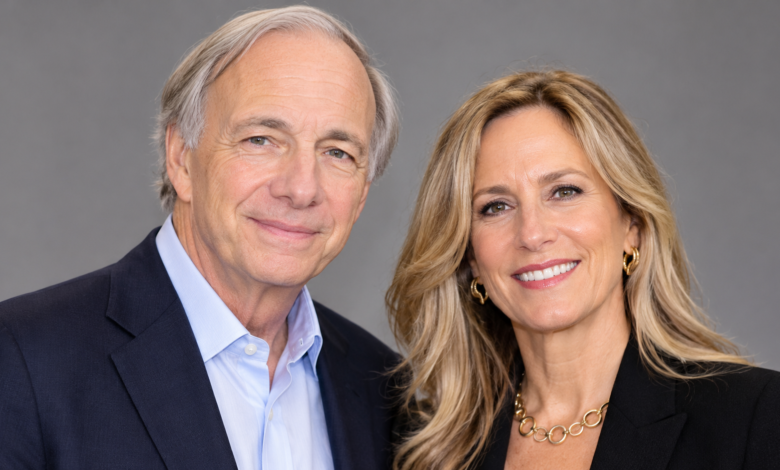
Leadership can look very different depending on the industry, the challenges involved, and the people being led. Ray Dalio and Patricia Poppe are good examples of this contrast. Dalio built his reputation in global investing and economics, while Poppe has developed her career around energy, operations, safety, customer service, and large-scale organizational leadership.
Although their professional worlds are quite different, both have spent decades dealing with complicated systems where decisions can have consequences far beyond the boardroom. Dalio became known for building Bridgewater Associates and developing a principles-driven approach to investing. Poppe, meanwhile, has held senior leadership positions in the utility sector and currently serves as CEO of PG&E Corporation.
Looking at Ray Dalio and Patricia Poppe together is interesting because their stories demonstrate two distinct approaches to solving problems. One focuses heavily on understanding economic cycles, markets, and decision-making systems, while the other emphasizes operational execution, safety, employees, customers, and infrastructure.
Ray Dalio’s Journey From Investor to Global Business Leader
Ray Dalio and Patricia Poppe Dalio’s interest in investing began surprisingly early. According to Bridgewater’s official biography, he became fascinated with markets at age 12 while working as a golf caddie on Long Island. He eventually bought his first stock and became increasingly interested in understanding how markets behaved. That early curiosity eventually developed into a career that would make him one of the best-known figures in modern investing.
After graduating from college, Dalio earned an MBA from Harvard Business School. He worked briefly on Wall Street before founding Bridgewater in 1975 from a two-bedroom apartment in New York City. What started as a relatively small operation eventually developed into a major global investment organization. Bridgewater’s history says Dalio served as CEO, CIO, and chairman during different stages of the firm’s development.
What makes Dalio particularly interesting is that he did not simply concentrate on picking investments. He developed a broader philosophy around how people make decisions, learn from mistakes, and understand cause-and-effect relationships. His approach eventually became closely associated with concepts such as radical transparency, meaningful work, and an “idea meritocracy.”
Patricia Poppe’s Rise Through the Energy Industry
Patricia “Patti” Poppe followed a very different route. Her education and early professional experience were strongly connected to engineering and industrial operations. She earned bachelor’s and master’s degrees in industrial engineering from Purdue University and later completed a master’s degree in management at Stanford Graduate School of Business.
Before reaching the top of the utility industry, Poppe spent years developing practical operational experience. Her career included approximately 15 years at General Motors, followed by leadership work at DTE Energy. She later joined CMS Energy and became president and CEO of CMS Energy and Consumers Energy in 2016.
That background is important because Poppe’s leadership style has been shaped by industries where execution matters every day. Utilities have to keep essential services operating while managing safety, infrastructure, employees, regulators, customers, costs, and long-term investment. Her career therefore reflects a hands-on approach to large-scale organizational management rather than a purely financial or theoretical one.
Ray Dalio and Patricia Poppe Have Different Leadership Philosophies
One of the most interesting ways to compare Ray Dalio and Patricia Poppe is through their approach to leadership. Dalio became famous for building systems around decision-making. His philosophy emphasizes learning from reality, examining mistakes, and making principles explicit so that people can use them repeatedly. Bridgewater describes his approach as one based on studying cause-and-effect relationships and stress-testing decisions.
Poppe’s leadership philosophy has been more closely associated with operational improvement and organizational transformation. At PG&E, the company says she has implemented lean business principles with an emphasis on improving operations, customer experience, efficiency, and resilience. Safety remains a central part of the company’s stated priorities under her leadership.
The difference is subtle but important. Dalio tends to approach complicated problems by asking what principles can explain recurring patterns. Poppe’s career demonstrates a stronger emphasis on improving the systems that employees and customers interact with every day. Both approaches depend on disciplined decision-making, but the environments in which they operate are very different.
The Importance of Learning From Mistakes
A major theme associated with Ray Dalio and Patricia Poppe Dalio is learning through mistakes. His philosophy suggests that setbacks should not simply be treated as failures. Instead, they can reveal weaknesses in an individual’s understanding or in the system being used to make decisions. This idea became a major part of his broader principles-based approach to work and life.
Poppe’s career also illustrates why organizations need to learn continuously. The utility sector faces complicated challenges involving aging infrastructure, climate-related risks, technology, customer expectations, affordability, and reliability. Managing such an organization requires leaders to identify problems, understand their causes, and continuously improve operations.
In that sense, Ray Dalio and Patricia Poppe share an important leadership lesson even though their industries are far apart: strong organizations cannot afford to treat learning as a one-time activity. Markets change, technologies change, customers change, and risks change. Leaders have to adapt while keeping their core objectives clear.
Patricia Poppe and the Challenge of Leading PG&E
Poppe became CEO of PG&E Corporation in January 2021 after previously serving as CEO of CMS Energy and Consumers Energy. Her appointment came at a particularly important period for PG&E, a company operating one of the country’s largest and most complicated utility systems.
At PG&E, Poppe has been responsible for an organization serving millions of people across Northern and Central California. The company says PG&E delivers energy services to approximately 16 million people, making reliability and safety central to the leadership challenge.
Her role also involves balancing multiple priorities. A modern utility must think about affordability, reliability, clean energy, infrastructure resilience, employee safety, technology, and customer trust at the same time. That makes Poppe’s position much broader than simply managing an energy company. It involves coordinating a huge network of people, physical assets, regulations, and public expectations.
Ray Dalio’s Influence Goes Beyond Investing
Dalio’s influence has also moved well beyond traditional investment management. Bridgewater describes how his ideas about principles, decision-making, culture, and economics have been shared through books, videos, and other educational material. His book Principles: Life & Work helped introduce his management philosophy to a much wider audience.
His investing philosophy also focuses on understanding economic history. Dalio has argued that studying historical cycles can help investors understand how economies and markets behave. Bridgewater’s description of his investment approach highlights the importance of examining long periods of economic history rather than relying only on recent events.
That perspective explains why Dalio’s name frequently appears in discussions about debt cycles, inflation, interest rates, geopolitical changes, and global economic trends. His career has effectively combined investment management with a broader attempt to understand how economic systems work.
What Ray Dalio and Patricia Poppe Can Teach Modern Leaders
The comparison between Ray Dalio and Patricia Poppe becomes especially useful when considering what today’s business leaders need. Neither operates in a simple environment. Dalio dealt with financial markets, where uncertainty is constant. Poppe operates in an essential-service industry where reliability and safety have immediate consequences.
One lesson is the importance of building systems instead of relying entirely on individual talent. Dalio built organizational processes around principles and decision-making. Poppe’s career has similarly involved improving operating systems, customer processes, and organizational performance. Both examples show why scalable systems become increasingly important as companies grow.
Another lesson is that leadership requires balancing long-term thinking with immediate execution. Investors have to make decisions today based on uncertain future conditions. Utility executives have to maintain today’s service while investing for tomorrow’s infrastructure and energy needs. In both situations, leaders cannot afford to focus exclusively on either the present or the distant future.
Their Careers Show Two Versions of Professional Success
It would be inaccurate to suggest that Ray Dalio and Patricia Poppe have followed similar career paths. Their industries, responsibilities, and professional experiences are substantially different. Dalio built an investment organization and became known internationally for his views on economics and decision-making. Poppe built her career through engineering, manufacturing, energy operations, and executive leadership.
Yet their careers reveal an interesting common thread: both have made complicated systems the center of their professional lives. Dalio studied financial and economic systems, while Poppe has spent much of her career working with industrial and utility systems.
That distinction makes their stories useful for people interested in business leadership. Success does not necessarily come from copying another leader’s personality or management style. Instead, effective leadership often comes from understanding the environment you operate in and developing a method that fits its unique challenges.
The Lasting Impact of Ray Dalio and Patricia Poppe
The long-term significance of Ray Dalio and Patricia Poppe comes from the different ways they have approached large organizations. Dalio’s legacy is closely tied to Bridgewater, his investment philosophy, and his principles for decision-making. Bridgewater notes that he transitioned away from the firm’s top executive roles and now focuses largely on mentoring and sharing what he has learned.
Poppe’s story is still unfolding. As CEO of PG&E Corporation, she remains involved in the company’s efforts to improve safety, reliability, operational efficiency, customer experience, and resilience. Her earlier leadership at Consumers Energy also established a track record in utility operations and clean-energy planning.
Ultimately, these two careers demonstrate that there is no single formula for becoming an effective leader. Dalio built a philosophy around principles, systems, and learning from reality. Poppe has built her reputation around engineering, operations, safety, customer service, and organizational transformation. Their paths are different, but both show the value of continuous learning and disciplined decision-making.
Frequently Asked Questions About Ray Dalio and Patricia Poppe
Who is Ray Dalio?
Ray Dalio and Patricia Poppe Dalio is an American investor and the founder of Bridgewater Associates, which he started in 1975. He became widely known for his work in global macro investing and for developing a principles-based approach to decision-making and organizational culture.
Who is Patricia Poppe?
Patricia “Patti” Poppe is the CEO of PG&E Corporation and a director of PG&E. Before joining PG&E in 2021, she served as president and CEO of CMS Energy and Consumers Energy.
What industries are Ray Dalio and Patricia Poppe associated with?
Dalio is primarily associated with investment management, economics, and financial markets. Poppe is primarily associated with utilities, energy, engineering, and large-scale operations.
What do Ray Dalio and Patricia Poppe have in common?
Their careers are different, but both have focused on improving complex organizations. Dalio emphasizes principles, decision-making, and understanding systems, while Poppe has focused heavily on operational performance, safety, customers, and organizational transformation.
Why are Ray Dalio and Patricia Poppe interesting to compare?
They offer two very different examples of modern leadership. Studying them together shows how principles such as continuous learning, disciplined decision-making, systems thinking, and long-term planning can be applied across completely different industries.
Conclusion
The story of Ray Dalio and Patricia Poppe is ultimately a story about two leaders solving very different kinds of problems. Dalio built his reputation by studying markets, economic cycles, organizational culture, and decision-making. Poppe has built hers through engineering, energy operations, customer-focused leadership, safety, and organizational improvement.
Their careers show that effective leadership is not about having one universal style. It is about understanding reality, recognizing challenges, building reliable systems, and being willing to adapt. Whether the problem involves global markets or millions of customers depending on an energy network, those fundamentals remain remarkably relevant.
For anyone studying successful business leaders, Ray Dalio and Patricia Poppe provide a useful contrast. Their professional journeys demonstrate that thoughtful leadership can take many forms—and that the strongest leaders are often the ones who keep learning long after they reach the top.
You May Also Read: Christian Bale and Noah Centineo