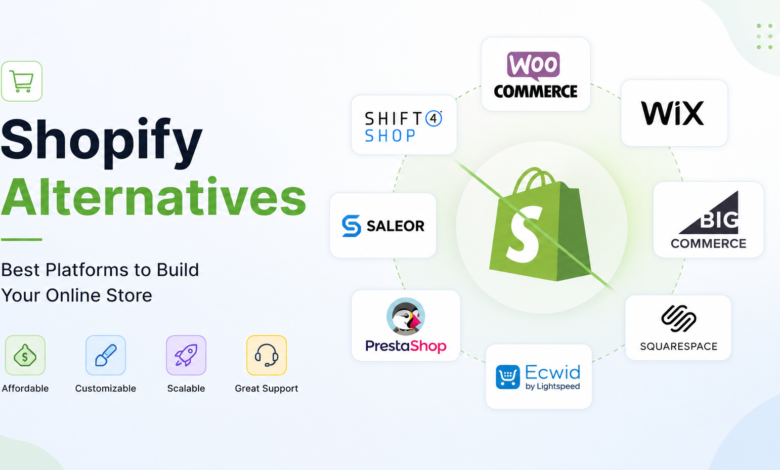
If you’re planning to launch an online store or thinking about moving away from Shopify, you’re definitely not alone. While Shopify is one of the biggest names in the e-commerce industry, it isn’t the perfect fit for every business. Pricing, customization limits, transaction fees, and specific business requirements often encourage entrepreneurs to explore other options. That’s why searching for the best Shopify alternatives has become increasingly common among online sellers.
The good news is that today’s market offers plenty of excellent e-commerce platforms that compete directly with Shopify. Some focus on affordability, while others provide greater flexibility, advanced customization, or specialized tools for certain industries. Whether you’re a beginner, a growing business, or an enterprise-level company, there’s a platform designed specifically for your needs.
In this guide, we’ll explore the best Shopify alternatives, compare their strengths, discuss who they’re best suited for, and help you choose the right platform for your online business.
Why People Look for Shopify Alternatives
Although Shopify is an outstanding platform, it isn’t always the ideal solution for everyone. Every online business has different priorities, and what works perfectly for one seller might not work for another.
One of the biggest reasons users search for Shopify alternatives is pricing. Shopify requires a monthly subscription, and additional costs often appear through premium themes, paid apps, transaction fees, and third-party integrations. These expenses can quickly add up, especially for startups with limited budgets.
Another common reason is customization. Shopify offers many design options, but developers sometimes find its customization limitations frustrating. Businesses wanting complete control over their website often prefer platforms that provide open-source flexibility or more extensive editing capabilities.
Scalability is another factor. While Shopify scales well, some companies require unique features like advanced B2B tools, custom checkout experiences, or specialized inventory management. In such cases, exploring different Shopify competitors becomes a smart business decision.
What Makes a Great Shopify Alternative?
Choosing the right platform isn’t just about finding something cheaper. The best Shopify alternatives should provide the right balance of features, ease of use, security, and future growth potential.
Ease of use matters because not every business owner has technical knowledge. A user-friendly dashboard allows you to manage products, orders, customers, and payments without hiring a developer. Simplicity can save both time and money.
Customization is equally important. A flexible platform lets you build a unique online store that reflects your brand rather than looking like thousands of other websites. Themes, plugins, coding access, and design options all contribute to creating a memorable shopping experience.
Marketing tools should also be considered. Built-in SEO, email marketing, abandoned cart recovery, blogging capabilities, social media integrations, and analytics help drive traffic and increase sales without relying heavily on third-party software.
WooCommerce: The Most Flexible Shopify Alternative
WooCommerce remains one of the most popular Shopify alternatives, especially for businesses already using WordPress. Since it’s open-source, users have nearly unlimited customization possibilities.
One major advantage of WooCommerce is ownership. Unlike hosted platforms, you control your website, hosting, and data. This level of freedom appeals to businesses wanting complete independence over their online presence.
WooCommerce also has thousands of themes, plugins, and extensions that allow sellers to build almost any type of online store imaginable. Whether you’re selling physical products, digital downloads, subscriptions, or memberships, WooCommerce can handle it efficiently.
The downside is that you’ll need to manage hosting, security updates, backups, and maintenance yourself or hire someone to do it. For users comfortable with WordPress, however, WooCommerce is one of the strongest Shopify competitors available today.
BigCommerce: Built for Growing Businesses
BigCommerce is another excellent choice among Shopify alternatives because it combines powerful built-in features with strong scalability.
Unlike many platforms that require numerous paid apps, BigCommerce includes many advanced tools by default. Features like SEO optimization, product filtering, multi-channel selling, and customer segmentation come built into the platform.
Businesses expecting rapid growth appreciate BigCommerce because it supports large product catalogs, international selling, and enterprise-level performance without sacrificing speed.
Its interface may feel slightly more complex for beginners compared to Shopify, but experienced store owners often appreciate the additional flexibility and professional-level features.
Wix eCommerce: Ideal for Beginners
If simplicity is your highest priority, Wix is one of the easiest Shopify alternatives available.
Its drag-and-drop website builder allows anyone to create an attractive online store without coding knowledge. Beginners can launch professional-looking websites within hours using hundreds of ready-made templates.
Wix also includes blogging, SEO tools, appointment booking, marketing automation, and email campaigns, making it a complete solution for small businesses.
While Wix works wonderfully for startups and small online stores, very large businesses with extensive inventories may eventually outgrow its capabilities.
Squarespace Commerce: Beautiful Design Comes First
For creative businesses, photographers, artists, designers, and boutique brands, Squarespace stands out among Shopify alternatives.
Its professionally designed templates are widely recognized for their clean, modern appearance. Businesses focused on branding often choose Squarespace because visual presentation plays a huge role in customer trust.
Squarespace includes integrated blogging, inventory management, analytics, and marketing features. Everything works together seamlessly without requiring dozens of plugins.
Although Squarespace may not offer the advanced inventory management found in enterprise platforms, it excels for visually driven businesses seeking elegance and simplicity.
Adobe Commerce (Magento): Enterprise-Level Power
Adobe Commerce, previously known as Magento, serves businesses with advanced technical requirements.
Among all Shopify alternatives, Adobe Commerce offers some of the deepest customization options available. Large retailers can build completely unique shopping experiences tailored to their operations.
The platform supports multiple stores, multiple languages, international currencies, advanced customer segmentation, personalized shopping experiences, and extensive API integrations.
However, Magento requires experienced developers and significant server resources. It’s not recommended for beginners or small startups due to its complexity and maintenance requirements.
OpenCart and PrestaShop: Budget-Friendly Open-Source Options
OpenCart and PrestaShop are often overlooked but remain excellent Shopify alternatives for businesses wanting open-source freedom without paying expensive monthly subscriptions.
OpenCart offers a lightweight interface that’s relatively easy to understand while supporting thousands of products and multiple payment gateways.
PrestaShop provides more advanced e-commerce features and enjoys a large international community that continually develops new themes and modules.
Both platforms require self-hosting and technical management, but they offer impressive flexibility at a relatively low overall cost.
How to Choose the Right Shopify Alternative
Finding the best Shopify alternatives depends entirely on your business goals rather than choosing the platform with the most features.
Start by identifying your budget. Monthly subscription costs, hosting fees, premium themes, plugins, payment processing, and maintenance should all be considered before making a decision.
Next, evaluate your technical experience. If you don’t want to deal with hosting or coding, hosted platforms like BigCommerce, Wix, and Squarespace provide a smoother experience.
Think about future growth as well. Switching platforms later can be time-consuming, so selecting software that supports your long-term business plans will save considerable effort down the road.
Key Features to Compare Before Switching
Before migrating your online store, compare essential features across different Shopify alternatives.
Look carefully at payment gateway compatibility. Some platforms charge additional transaction fees while others allow greater flexibility with payment providers.
SEO capabilities should also receive close attention. Clean URLs, customizable metadata, structured data support, XML sitemaps, fast loading speeds, and mobile responsiveness all contribute to better search engine rankings.
Customer support is another critical factor. Reliable technical assistance becomes invaluable whenever issues arise. Some platforms provide 24/7 live chat, while others mainly rely on community forums or documentation.
Common Mistakes When Choosing Shopify Alternatives
Many entrepreneurs make the mistake of selecting a platform based solely on price. While affordability matters, long-term functionality should always come first.
Another common mistake is ignoring scalability. A platform that works perfectly for 20 products might struggle once your inventory reaches several thousand items.
Business owners also sometimes underestimate migration complexity. Product data, customer information, SEO URLs, images, reviews, and order history should all be transferred carefully to avoid losing valuable business data.
Finally, don’t overlook integrations. Ensure your chosen platform works smoothly with accounting software, email marketing tools, shipping providers, inventory systems, and CRM platforms that your business depends on.
Final Thoughts
Choosing between today’s many Shopify alternatives doesn’t have to be overwhelming. Every platform offers its own strengths, making it suitable for different types of businesses and entrepreneurs.
If flexibility and ownership are your priorities, WooCommerce is an outstanding choice. Businesses planning rapid expansion may benefit from BigCommerce’s powerful built-in tools. Creative brands often thrive on Squarespace, while beginners appreciate Wix’s simplicity. Large enterprises requiring maximum customization can confidently consider Adobe Commerce.
Ultimately, the best Shopify alternatives are the ones that align with your business goals, budget, technical expertise, and future growth plans. Take time to evaluate your needs carefully before making a decision. A well-chosen e-commerce platform can become the foundation for years of successful online selling, allowing you to focus less on technology and more on growing your brand, serving your customers, and increasing your revenue.
You May Also Read: OptinMonster