Hardest Languages to Learn: A Complete Guide to the World’s Most Challenging Languages

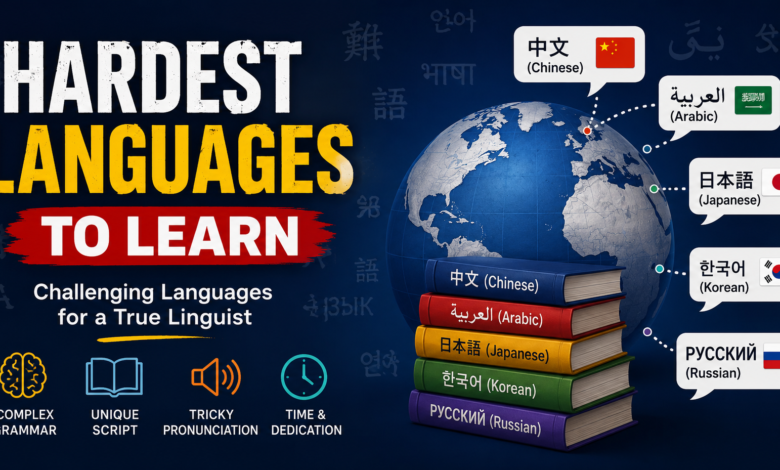
Hardest Languages to Learn, Learning a new language is one of the most rewarding skills you can develop, but not every language offers the same level of difficulty. While some languages have familiar grammar and vocabulary, others introduce entirely new writing systems, pronunciation patterns, and sentence structures that can make the learning process feel overwhelming. This is why many people search for the hardest languages to learn before deciding which language to study.
The truth is that language difficulty depends on your native language, previous learning experience, and how much time you dedicate to practice. For an English speaker, languages that belong to completely different language families usually require much more effort than those with shared roots. Factors such as unfamiliar alphabets, tonal pronunciation, complex grammar, and thousands of unique characters all contribute to making a language difficult.
In this guide, we’ll explore the hardest languages to learn, explain what makes them so challenging, and share practical strategies that can help you master even the most demanding languages. Whether you’re learning for travel, business, education, or personal growth, understanding these challenges will prepare you for a successful language-learning journey.
What Makes Some Languages So Difficult to Learn?
One of the biggest reasons certain languages are considered among the hardest languages to learn is their grammatical complexity. Some languages contain dozens of verb forms, multiple noun cases, gender agreements, and sentence structures that differ completely from English. Instead of following familiar rules, learners must adapt to an entirely new way of thinking and communicating.
Writing systems also play a huge role. While English uses the Latin alphabet, many difficult languages rely on unique scripts or thousands of individual characters. Learning to read and write in languages such as Chinese, Japanese, or Arabic often takes months or even years of dedicated practice before learners become comfortable.
Pronunciation presents another major challenge. Some languages include sounds that simply don’t exist in English. Tonal languages, for example, require speakers to change pitch in order to change meaning. A single word pronounced with a different tone can mean something entirely different, making listening and speaking especially demanding for beginners.
Mandarin Chinese: One of the Hardest Languages to Learn
When discussing the hardest languages to learn, Mandarin Chinese almost always appears at the top of the list. Although its grammar is surprisingly straightforward compared to many European languages, the language introduces challenges unlike almost any other.
The biggest obstacle is the writing system. Instead of learning an alphabet, students must memorize thousands of Chinese characters. While basic literacy requires knowledge of around 2,000 to 3,000 characters, educated native speakers often know many more. Memorization becomes an ongoing part of the learning process.
Mandarin is also a tonal language with four primary tones and one neutral tone. The same syllable can have several meanings depending on the tone used. For beginners, distinguishing these tones while listening and reproducing them accurately can take significant practice.
Japanese: A Language with Multiple Writing Systems
Japanese consistently ranks among the hardest languages to learn because it combines several complex features into one language. Unlike many languages that use a single alphabet, Japanese relies on three writing systems: Hiragana, Katakana, and Kanji.
Kanji alone represents one of the biggest hurdles. These characters originated from Chinese and require learners to memorize thousands of symbols, each with multiple possible pronunciations depending on context. Even advanced students continue expanding their Kanji knowledge throughout their studies.
Grammar also differs dramatically from English. Japanese sentence structure places verbs at the end of sentences, uses numerous levels of politeness, and frequently omits subjects when context makes them obvious. These differences require learners to completely rethink how they construct sentences.
Arabic: A Beautiful Yet Challenging Language
Arabic is another language that regularly appears on lists of the Hardest Languages to Learn languages to learn. Its unique script, rich grammar, and wide variety of regional dialects make it an ambitious but rewarding language to study.
The Arabic alphabet is written from right to left, which immediately feels unfamiliar to many new learners. Letters also change their appearance depending on whether they appear at the beginning, middle, or end of a word. Reading becomes easier with practice, but the adjustment period can be significant.
Another challenge is pronunciation. Arabic contains several sounds that have no direct English equivalent, especially the deep throat consonants. Mastering these sounds requires patience and consistent listening practice.
Perhaps the biggest obstacle is the difference between Modern Standard Arabic and regional dialects. Learners often study one version in textbooks but discover that everyday conversations vary greatly depending on the country.
Korean: Logical but Surprisingly Difficult
Many people assume Korean is easier than other Asian languages because its alphabet, Hangul, is considered highly logical. While Hangul itself can be learned relatively quickly, Korean still deserves its place among the hardest languages to learn.
Grammar differs significantly from English. Korean sentences typically follow a subject-object-verb structure, requiring learners to adjust their thinking patterns. Verbs also change based on politeness, social relationships, and context.
Honorific speech adds another layer of complexity. Choosing the correct level of formality depends on age, status, and the relationship between speakers. Making mistakes usually won’t stop communication, but using the wrong speech level can sound awkward or even disrespectful.
Vocabulary presents another challenge because many words have Chinese origins while others are purely Korean, giving learners multiple systems to understand over time.
Russian: Complex Grammar and Pronunciation
Russian is often listed among the hardest languages to learn because of its extensive grammar rules and unfamiliar alphabet. Although the Cyrillic alphabet can be mastered within a few weeks, grammar requires much longer to understand.
Russian nouns change according to six grammatical cases, meaning word endings constantly change depending on their role in a sentence. Adjectives, pronouns, and numerals must also agree with these changes, creating numerous rules for learners to memorize.
Verb conjugations include aspects that distinguish completed actions from ongoing ones. Understanding when to use each form can be confusing, especially during conversations.
Pronunciation also introduces challenges through consonant clusters that rarely appear in English, making some Russian words difficult to pronounce correctly during the early stages of learning.
Hungarian: Europe’s Hidden Challenge
Hungarian surprises many language learners because it is widely considered one of Europe’s most difficult languages. Unlike most European languages, Hungarian belongs to the Uralic language family, meaning it shares very little vocabulary with English.
The language uses more than a dozen grammatical cases, allowing word endings to express meanings that English communicates through separate words like “to,” “from,” or “with.” Remembering these endings takes considerable practice.
Hungarian also relies heavily on vowel harmony, a system where suffixes change depending on the vowels within a word. This adds another set of grammatical rules that learners must internalize before speaking naturally.
Despite its complexity, Hungarian follows consistent pronunciation rules, making reading easier once learners understand the alphabet.
Finnish: Simple Pronunciation but Complex Grammar
Finnish often appears in discussions about the hardest languages to learn because its grammar differs dramatically from Indo-European languages. While pronunciation is relatively straightforward, grammar quickly increases the level of difficulty.
Finnish contains around fifteen grammatical cases that replace many prepositions used in English. Instead of separate words, endings attached to nouns express location, movement, possession, and many other meanings.
Long compound words are another characteristic feature. A single Finnish word may contain information that would require an entire phrase in English, making vocabulary look intimidating at first.
Fortunately, Finnish pronunciation is highly consistent. Once learners understand the sounds of each letter, they can usually pronounce unfamiliar words correctly without much guesswork.
Is the Hardest Language the Same for Everyone?
Although rankings of the hardest languages to learn are popular, there is no single answer that applies to everyone. Language difficulty depends heavily on your native language and previous experience.
For example, an English speaker may find Mandarin or Arabic extremely challenging, while a native Chinese speaker may struggle much more with Russian grammar or Hungarian sentence structure. Similarly, Spanish speakers often learn Italian more quickly than Japanese because of shared vocabulary and grammar.
Motivation also plays a major role. A language that feels impossible in a classroom may become much easier if you’re surrounded by native speakers or genuinely passionate about the culture. Daily exposure, meaningful conversations, and regular practice often matter more than the language’s reputation.
Instead of focusing only on difficulty rankings, it’s better to choose a language that aligns with your personal goals. Enthusiasm can overcome many learning obstacles.
Tips for Learning Difficult Languages Successfully
Studying one of the hardest languages to learn requires patience, consistency, and realistic expectations. Rather than trying to memorize everything at once, focus on building small daily habits that gradually strengthen your skills.
Spend time listening to native speakers every day, even if you don’t understand everything. Podcasts, television shows, music, and online videos help train your ears to recognize natural pronunciation and rhythm. Regular listening improves comprehension much faster than occasional study sessions.
Vocabulary retention improves through repetition. Flashcards, spaced repetition software, and frequent review help move new words into long-term memory. Learning vocabulary in complete sentences rather than isolated lists also improves recall.
Speaking should begin as early as possible. Many learners delay conversation until they feel “ready,” but regular speaking practice builds confidence and reveals areas that need improvement. Mistakes are an essential part of language acquisition and should be viewed as opportunities to grow.
Conclusion
Choosing to study one of the hardest languages to learn is undoubtedly a significant challenge, but it is also an incredibly rewarding achievement. Languages such as Mandarin Chinese, Japanese, Arabic, Korean, Russian, Hungarian, and Finnish demand dedication because of their unique writing systems, grammar, pronunciation, and vocabulary. However, none of these challenges are impossible to overcome with consistent effort and the right learning strategy.
Remember that language learning is not a race. Progress happens gradually through daily exposure, regular practice, and real-life communication. Even the world’s most difficult languages become manageable when broken into small, achievable goals. Whether your motivation is career advancement, travel, cultural appreciation, or personal development, mastering one of the hardest languages to learn can open doors to entirely new opportunities and experiences.
You May Also Read: Visual Capitalist