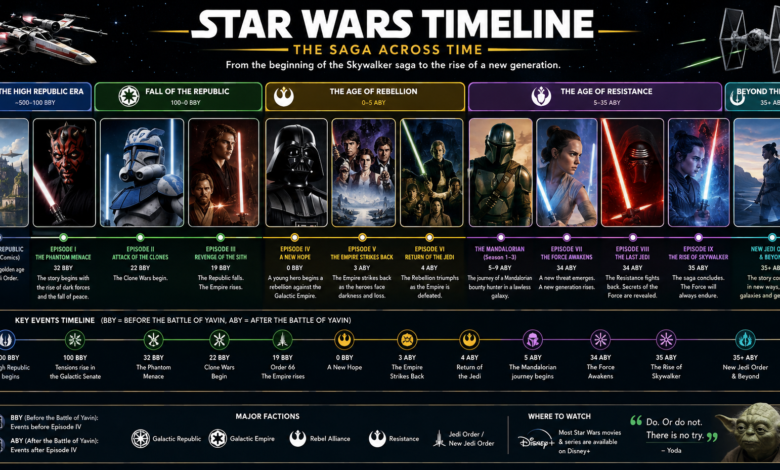
The Star Wars timeline can feel complicated at first. There are nine main saga films, animated series, live-action shows, spin-off movies, anthology stories, and newer projects that explore periods thousands of years apart. The good news is that once the major eras are understood, the entire galaxy becomes much easier to follow. Official Star Wars Timeline .com material now organizes the story into broad historical eras, while its chronological viewing guide places the movies and series in their in-universe order.
Unlike the real-world release dates, the Star Wars Timeline Wars universe has its own internal chronology. The familiar BBY and ABY system is commonly used by fans to describe events before and after the Battle of Yavin, the major turning point depicted in A New Hope. That means a story released in 2024 can take place hundreds or even thousands of years before a movie released decades earlier. Understanding that difference is the key to making sense of the Star Wars timeline.
The Dawn of the Jedi and the Earliest Star Wars History
The earliest part of the Star Wars timeline reaches far beyond the Skywalker family. Official StarWars.com material identifies the Dawn of the Jedi as an era in which the Jedi Order emerges and the Republic is established among worlds of the Galactic Core. This period represents some of the deepest history in the galaxy, long before the events audiences first encountered in the original trilogy.
The Jedi eventually become closely associated with protecting the Republic and maintaining peace. Their relationship with the Force, however, is not always simple. Over immense stretches of galactic history, disagreements about the Force contribute to conflicts and schisms, including the rise of the Sith. These ancient developments establish the philosophical struggle between the light and dark sides that continues throughout the franchise.
This part of the timeline is especially interesting because it shows that Star Wars Timeline Wars is much bigger than the Skywalker family. The movies mostly focus on a relatively narrow period of galactic history, while the broader universe contains civilizations, Jedi traditions, wars, and political changes that happened long before Anakin Skywalker was born. Lucasfilm’s official eras are designed to provide that larger historical context.
The High Republic Era
The High Republic is one of the most important periods for understanding the modern expansion of the Star Wars timeline. It takes place centuries before The Phantom Menace, when the Jedi Order is portrayed as being near the height of its influence. The era has been explored through novels, comics, and other stories rather than being centered primarily on the nine Skywalker Saga films.
One of the major events associated with the High Republic is the Great Disaster, which creates enormous challenges for the Republic and Jedi. Stories from this period introduce new heroes, enemies, locations, and political situations while showing a galaxy that feels noticeably different from the one audiences know from the prequel trilogy.
The High Republic is useful for fans because it demonstrates how flexible the Star Wars timeline can be. Instead of constantly returning to familiar characters, these stories can explore new generations of Jedi and different corners of the galaxy. Official publishing guides divide the High Republic initiative into different phases, including Quest of the Jedi, Light of the Jedi, and Trials of the Jedi.
The Acolyte and the Road Toward the Prequel Era
One of the more recent additions to the chronological timeline is The Acolyte. The series is set during the later part of the High Republic period and therefore takes place before The Phantom Menace. In Lucasfilm’s official chronological viewing guide, The Acolyte comes first among the listed movies and series.
This placement matters because it gives viewers a look at the Jedi before the political circumstances of the prequel trilogy fully develop. The Jedi Order is still powerful, but the story explores mysteries and tensions that hint at problems beneath the surface.
For viewers following the Star Wars timeline, The Acolyte provides useful historical distance from the Skywalker Saga. You are not watching Anakin, Luke, or Rey yet. Instead, you are seeing another generation of characters whose experiences help expand the history of the Jedi and Sith.
The Prequel Trilogy: Anakin Skywalker’s Story
The next major stage begins with Star Wars: Episode I – The Phantom Menace. This is where the story moves into the familiar period immediately preceding the Clone Wars. Anakin Skywalker is introduced as a young boy on Tatooine, while Obi-Wan Kenobi and Qui-Gon Jinn become central to his introduction to the Jedi world.
Attack of the Clones then moves the story forward and shows Anakin as a young Jedi. The political situation has deteriorated, and the galaxy is heading toward a massive conflict. The Clone Wars begin, creating the circumstances that will eventually transform the Republic and dramatically change Anakin’s life.
The prequel period reaches its tragic climax in Revenge of the Sith. The Clone Wars are nearing their conclusion, the Jedi are decimated, and Chancellor Palpatine’s plan finally succeeds. Anakin falls to the dark side and becomes Darth Vader, while the Galactic Republic is replaced by the Galactic Empire. Official StarWars.com material describes this transition as the collapse of the Republic and the rise of the Empire.
The Clone Wars: The Galaxy at War
The Clone Wars occupies a huge and important section of the Star Wars timeline. The animated The Clone Wars series takes place between Attack of the Clones and Revenge of the Sith, filling in many events that the films only briefly mention.
During this period, Anakin becomes the mentor of Ahsoka Tano, one of the most important characters introduced outside the original films. Obi-Wan continues serving as a Jedi General, while countless clone troopers fight across the galaxy. The conflict also gives characters such as Darth Maul, Asajj Ventress, and Count Dooku much more room to develop.
The chronological placement of The Clone Wars can be confusing because its episodes were not originally released in strict chronological story order. Lucasfilm has published an official sequential episode order to help viewers experience the events correctly. For anyone attempting a detailed Star Wars timeline marathon, that episode order is worth using.
The Rise of the Galactic Empire
After the events of Revenge of the Sith, the galaxy enters one of its darkest periods. The Jedi have been largely destroyed, Palpatine rules as Emperor, and Darth Vader becomes one of the Empire’s most feared figures. The transformation is not instantaneous from a storytelling perspective, though; several stories explore how the new Imperial government establishes control.
The Bad Batch is particularly important in this part of the timeline. It follows a group of clone troopers during the transition from the Republic to the Empire. Their story provides a closer look at what happens to clones and soldiers after the Clone Wars officially ends.
Solo: A Star Wars Timeline Wars Story also belongs to this general era. The film follows a younger Han Solo and explores his early life before he becomes the famous smuggler seen in the original trilogy. The story adds context to Han’s relationship with Chewbacca, the Millennium Falcon, and the criminal underworld.
Obi-Wan Kenobi, Andor, Rebels, and the Growing Rebellion
As the Empire becomes stronger, resistance movements begin appearing throughout the galaxy. Obi-Wan Kenobi explores a period when the former Jedi Master is living in hiding after the destruction of the Jedi Order. The story provides a bridge between the prequel trilogy and the original trilogy.
Andor and Star Wars Timeline Wars Rebels explore the growing rebellion from different perspectives. These stories show that the fight against the Empire is not simply about famous Jedi and Sith. Ordinary people, spies, soldiers, pilots, senators, and activists all contribute to the resistance.
Official Star Wars Timeline .com guidance places Andor and Rebels around the same general period, with both leading toward Rogue One. This is one of the most satisfying connections in the Star Wars timeline, because the individual stories gradually converge on the events that begin A New Hope.
Rogue One and A New Hope
Rogue One: A Star Wars Timeline Wars Story takes place immediately before A New Hope. Its central mission revolves around obtaining the Death Star Wars Timeline plans, making it a direct setup for the original 1977 film. StarWars.com describes this event as a key moment in the timeline because ordinary people undertake an extraordinary mission that becomes part of the larger rebellion.
After Rogue One, the story flows directly into A New Hope. Luke Skywalker enters the larger galactic conflict, Leia Organa continues her fight against the Empire, and Han Solo becomes involved in a mission that changes his life. The destruction of the first Death Star Wars Timeline gives the Rebel Alliance a major victory.
This is where the classic Skywalker Saga truly takes center stage. Although many stories happen before it, A New Hope remains the foundation around which much of the modern franchise was built. It introduces the characters and conflict that later films repeatedly revisit.
The Original Trilogy and the Fall of the Empire
The Empire Strikes Back follows the events of A New Hope and dramatically raises the stakes. The Empire remains powerful, Luke begins developing his connection to the Force, and the relationship between Luke and Darth Vader becomes central to the story.
Return of the Jedi then brings the original trilogy to its emotional conclusion. Luke confronts Vader and Emperor Palpatine, while the Rebel Alliance launches another major attack against the Empire. Vader ultimately turns against Palpatine, allowing Luke to survive and helping bring about the Emperor’s defeat.
The original trilogy represents one of the most important turning points in the Star Wars timeline. The Galactic Empire suffers a devastating defeat, but the galaxy does not suddenly become peaceful. The following decades contain political struggles, remnants of Imperial power, and new threats that eventually lead to the sequel trilogy.
The New Republic and the Rise of the First Order
After Return of the Jedi, the galaxy begins rebuilding. Stories such as The Mandalorian, The Book of Boba Fett, and Ahsoka explore different corners of this post-Empire period. Rather than focusing exclusively on a single galactic conflict, these stories examine the consequences of the Empire’s fall.
The Mandalorian introduces Din Djarin and Grogu while exploring a galaxy still dealing with the aftermath of Imperial rule. The Book of Boba Fett expands the story around Tatooine and its criminal underworld, while Ahsoka continues threads connected to characters from The Clone Wars and Rebels.
This period is particularly valuable because it shows that defeating an empire does not automatically erase its influence. Imperial remnants, former soldiers, political uncertainty, and unresolved conflicts continue shaping the galaxy. These developments eventually lead toward the emergence of the First Order.
The Sequel Trilogy and the Final Skywalker Conflict
The sequel era begins with The Force Awakens, set decades after the original trilogy. The First Order has risen from the remnants of the Empire, while the Resistance struggles to confront the new threat. Rey, Finn, Poe Dameron, Kylo Ren, Han Solo, Leia Organa, and Luke Skywalker become central to the next chapter.
The Last Jedi continues the story while examining the legacy of the Jedi and the difficult choices faced by Rey and Kylo Ren. Luke’s relationship with the Jedi Order becomes particularly important as the film questions what the next generation should inherit from the past.
The saga concludes with The Rise of Skywalker. The Resistance faces its greatest challenge, Rey confronts her identity and destiny, and the conflict between the light and dark sides reaches its final major cinematic chapter. Lucasfilm’s chronological guide places the three sequel films after the events of The Mandalorian era and related stories.
Where the Star Wars Timeline Goes Next
One reason the Star Wars timeline continues to grow is that Lucasfilm is no longer telling stories in only one period. New projects can move backward into ancient history, explore the High Republic, revisit the Imperial era, or examine the galaxy after the Skywalker Saga.
This approach gives creators considerable freedom. A story set hundreds of years before Anakin Skywalker does not need to constantly explain what Luke or Darth Vader is doing. Likewise, stories set after the original trilogy can explore the consequences of the Empire without repeating the exact same conflict.
The official Star Wars Timeline .com era system reflects this broader approach. Instead of treating Star Wars as one straight story about a single family, the franchise now presents its history as a collection of interconnected periods spanning thousands of years.
What Is the Best Way to Watch the Star Wars Timeline?
There is no single perfect viewing order. Lucasfilm itself provides both release-order and chronological guides, and its official guide notes that either approach can work depending on the viewer.
For a first-time viewer, release order has a strong advantage because it preserves the way audiences originally discovered the story. Starting with A New Hope introduces the central mythology naturally, followed by The Empire Strikes Back and Return of the Jedi. The prequel trilogy can then explain how the galaxy reached that point.
For someone who already knows the major twists, chronological order can be extremely enjoyable. Starting with The Acolyte, then moving through the prequel era, The Clone Wars, the Imperial period, the original trilogy, and finally the sequel era creates a long historical journey through the galaxy. The official chronological guide provides a detailed version of this approach.
Final Thoughts on the Star Wars Timeline
The Star Wars timeline is no longer just a sequence of nine movies. It has become a huge fictional history containing ancient Jedi traditions, Republic politics, the Clone Wars, the rise and fall of the Empire, the rebellion, the New Republic, the First Order, and stories that extend beyond the Skywalker family’s central journey.
What makes the timeline fascinating is the way different stories connect without always following the same characters. Ahsoka’s journey can begin during the Clone Wars and eventually lead into stories set decades later. The rebellion develops across several shows before connecting directly with Rogue One. Meanwhile, the sequel era introduces a new generation while continuing themes established in the original trilogy.
If you are building your own viewing marathon, the best approach is to decide whether you want the experience of release order or the historical flow of chronological order. For newcomers, release order remains an excellent introduction. For longtime fans, chronological viewing can reveal connections that are easy to miss when jumping between different release periods. Either way, the galaxy far, far away has enough history to keep even experienced fans discovering something new.
You May Also Read: Selfie Point Design