Introduction
The FCF formula is one of the most important financial metrics used by investors, business owners, and financial analysts. While profits and revenue often grab the headlines, free cash flow tells the real story about a company’s financial health. It reveals how much cash a business generates after covering its operating expenses and capital investments.
Understanding the FCF formula is essential if you want to evaluate whether a company is financially strong, capable of paying dividends, reducing debt, or funding future growth. Unlike accounting profits, free cash flow focuses on actual cash available, making it a reliable indicator of long-term business performance.
Whether you’re a beginner learning finance or an experienced investor analyzing stocks, this guide will explain everything you need to know about the FCF formula in simple language. By the end of this article, you’ll understand how to calculate free cash flow, why it matters, and how to use it to make better financial decisions.
What Is the FCF Formula?
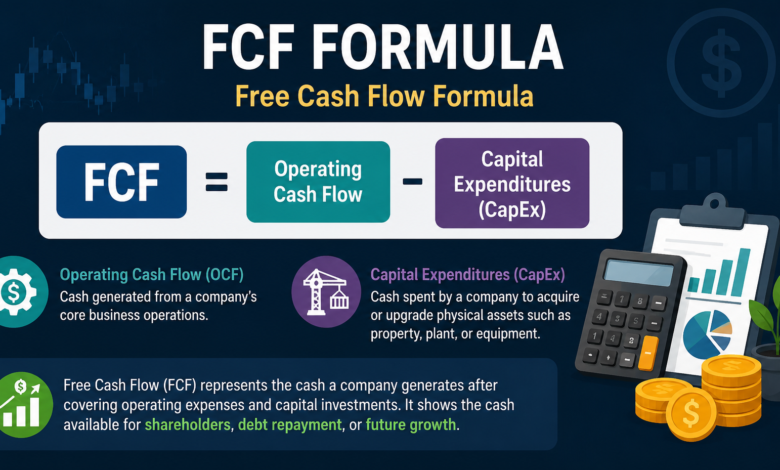
The FCF formula stands for Free Cash Flow Formula, which measures the amount of cash a company generates after spending money to maintain or expand its assets. It represents the cash that remains available for shareholders, debt repayment, acquisitions, or reinvestment into the business.
One of the most commonly used versions of the FCF formula is:
Free Cash Flow (FCF) = Operating Cash Flow – Capital Expenditures (CapEx)
Operating cash flow refers to the cash generated from normal business operations, while capital expenditures include investments in equipment, buildings, machinery, and other long-term assets. By subtracting CapEx from operating cash flow, businesses determine the cash they truly have available.
The FCF formula is widely used because it removes many accounting adjustments that can make net income look better or worse than reality. Investors often trust free cash flow more than earnings because cash is harder to manipulate than accounting profits.
Understanding Each Component of the FCF Formula
Before calculating free cash flow, it’s important to understand each part of the FCF formula. Every component provides valuable insight into a company’s financial activities.
The first component is Operating Cash Flow (OCF). This figure is found on the company’s cash flow statement and shows how much cash the business generates through its regular operations. It excludes financing and investing activities, making it a pure measure of operational performance.
The second component is Capital Expenditures (CapEx). These are investments made to purchase, upgrade, or maintain physical assets like factories, vehicles, equipment, and technology infrastructure. Companies that are growing rapidly often have higher capital expenditures.
When you subtract CapEx from Operating Cash Flow, you arrive at free cash flow. A positive result indicates that the company is generating more cash than it needs to maintain its operations, while a negative result may suggest heavy investment or financial challenges.
Different Versions of the FCF Formula
Although the basic FCF formula is the most popular, finance professionals sometimes use alternative versions depending on the purpose of the analysis.
One alternative formula is:
FCF = EBIT × (1 − Tax Rate) + Depreciation & Amortization − Capital Expenditures − Change in Working Capital
This version is commonly used in financial modeling because it starts with operating earnings rather than cash flow from operations.
Another variation focuses on Free Cash Flow to the Firm (FCFF), which measures cash available to both debt holders and shareholders. Analysts often use FCFF when valuing entire businesses using discounted cash flow (DCF) analysis.
There’s also Free Cash Flow to Equity (FCFE), which represents the cash available specifically for shareholders after debt obligations have been met. Investors frequently use FCFE when estimating the intrinsic value of a company’s stock.
Step-by-Step Example of the FCF Formula
Let’s calculate the FCF formula using a simple example.
Imagine a company reports the following financial data:
- Operating Cash Flow: $750,000
- Capital Expenditures: $250,000
Using the formula:
FCF = Operating Cash Flow – Capital Expenditures
FCF = $750,000 – $250,000
Free Cash Flow = $500,000
This means the company has generated half a million dollars in excess cash after covering its necessary investments. That money can now be used for paying dividends, reducing debt, buying back shares, or investing in future expansion.
Now consider another example where Operating Cash Flow is $400,000 and Capital Expenditures total $500,000. The free cash flow becomes negative at -$100,000. While negative free cash flow isn’t always bad—especially for growing companies—it requires further investigation.
Why the FCF Formula Is Important
The FCF formula plays a critical role in evaluating business performance because cash ultimately determines whether a company survives and grows.
One major advantage is that free cash flow measures actual cash rather than accounting profits. Companies can report high earnings while struggling with cash shortages, making FCF a more dependable indicator.
Investors also use the FCF formula to assess dividend sustainability. Businesses with consistently strong free cash flow are more likely to continue paying dividends even during economic downturns.
Another benefit is that lenders often review free cash flow before approving loans. Strong cash generation indicates that a company has the financial ability to meet its debt obligations and invest in future opportunities.
Advantages of Using the FCF Formula
The FCF formula offers several advantages over traditional financial metrics.
First, it provides a realistic picture of financial health. Since it focuses on cash instead of accounting profits, it gives investors greater confidence in the company’s ability to generate real value.
Second, free cash flow supports better valuation models. Financial analysts frequently use the FCF formula in discounted cash flow (DCF) analysis to estimate a company’s intrinsic value.
Third, companies with healthy free cash flow generally have greater financial flexibility. They can pursue acquisitions, expand operations, repay debt, increase dividends, or repurchase shares without relying heavily on external financing.
Finally, free cash flow often predicts long-term success better than short-term earnings because sustainable cash generation is essential for business growth.
Limitations of the FCF Formula
Although the FCF formula is highly valuable, it also has certain limitations.
One challenge is that capital expenditures can fluctuate significantly from year to year. A company may invest heavily in new facilities one year, temporarily reducing free cash flow despite having a healthy business.
Another limitation is that different industries have different capital requirements. Manufacturing companies naturally spend more on equipment than software companies, making direct comparisons difficult.
The FCF formula also doesn’t capture every aspect of financial performance. Investors should combine free cash flow with revenue growth, profitability, debt levels, and competitive position to gain a complete understanding of a company’s financial health.
Common Mistakes When Using the FCF Formula
Many beginners make errors when calculating the FCF formula, leading to inaccurate conclusions.
One common mistake is confusing net income with operating cash flow. Net income includes many non-cash accounting adjustments, whereas operating cash flow reflects actual cash movement.
Another mistake is ignoring capital expenditures altogether. Some investors look only at operating cash flow without subtracting CapEx, which overstates the company’s available cash.
People also make the mistake of evaluating only a single year’s free cash flow. It’s much more useful to analyze several years of data to identify long-term trends and business consistency.
How Investors Use the FCF Formula
Professional investors rely heavily on the FCF formula when selecting stocks.
Value investors search for companies with consistently growing free cash flow because these businesses often possess strong competitive advantages and stable operations.
Growth investors also monitor free cash flow, even though younger companies may temporarily generate negative values while investing aggressively in expansion. Understanding the reason behind negative FCF is crucial before making investment decisions.
Financial analysts incorporate the FCF formula into valuation models, forecasting future free cash flow and discounting it back to present value. This process helps estimate whether a company’s stock is fairly valued, undervalued, or overvalued.
Tips for Improving Free Cash Flow
Businesses continuously seek ways to improve their free cash flow.
One effective strategy is increasing operational efficiency. Reducing unnecessary expenses while maintaining revenue boosts operating cash flow naturally.
Companies can also improve working capital management by collecting customer payments faster, managing inventory efficiently, and negotiating better payment terms with suppliers.
Another approach is carefully planning capital expenditures. Investing only in projects that generate strong long-term returns helps maximize the benefits of the FCF formula without unnecessary spending.
Conclusion
The FCF formula is one of the most powerful financial tools available for evaluating a company’s true financial performance. Unlike earnings, which can be influenced by accounting methods, free cash flow measures the actual cash remaining after essential investments have been made.
By understanding the FCF formula, investors can make more informed decisions, business owners can better manage financial resources, and analysts can create more accurate company valuations. While no single metric should be used in isolation, free cash flow remains one of the strongest indicators of financial strength and long-term sustainability.
Whether you’re analyzing stocks, managing a business, or studying corporate finance, mastering the FCF formula will help you understand how companies generate value beyond reported profits. As you continue exploring financial analysis, free cash flow will become one of the most valuable metrics in your toolkit.
You May Also Read: Gelato USA LLC